FUTURE SOIL
Couldn't load pickup availability
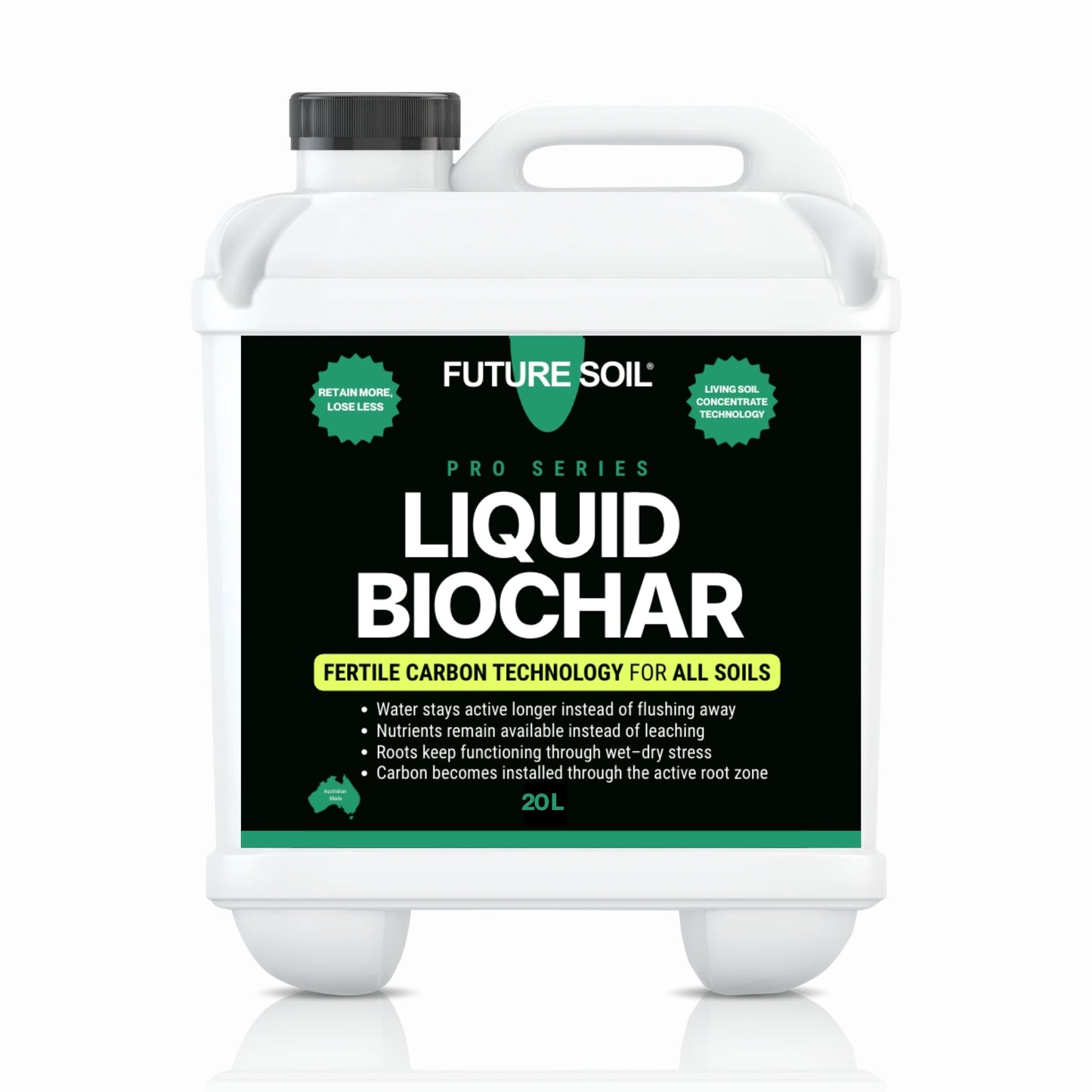
FS LIQUID BIOCHAR
One complete system for building, feeding and activating soil.
Putting expensive nutrients & water into dead soil?
Upgrade the root zone so water and nutrients stay useful for longer.
Unlock a new level of soil performance with our world first liquid carbon system engineered to upgrade the entire root zone. This advanced formula improves how soil captures and holds moisture, keeps nutrients where roots can reach them, supports beneficial soil life, and encourages deeper, stronger root growth.

Australia Made Technology
Four functions. One bottle.
1. Stable Biocarbon Platform improves aeration, moisture holding, microbial housing.
2. Improves how water spreads, penetrates and remains available in the soil profile.
3. Supports active root–microbe interaction and improves nutrient cycling efficiency.
4. Pre-loaded trace nutrients to support the carbon systems' & improve soil integration.

What It Means for Gardeners & Landscapers
- Holds moisture longer in lawns, beds and containers.
- Reduces watering frequency and improves consistency.
- Makes fertiliser work harder by keeping nutrients in the root zone.
- Supports stronger, deeper root systems.
- Reduces dry spots and uneven growth.
- Improves plant resilience during heat and stress.
- Delivers better colour, density and uniform performance across the site.
Built for All Soil Types
Sandy soils that drain too quickly.
Clay soils that behave inconsistently.
Established gardens that need optimisation.
High-performance landscapes that demand reliability.
If you irrigate, fertilise and expect visible results, FUTURE SOIL® LIQUID BIOCHAR upgrades the system beneath the surface.
- More efficiency.
- More resilience.
- More output from the same ground.
Why It Matters
- Water goes further.
- Nutrients last longer.
- Stress has less impact.
- Results become more predictable.
- You do not need more input.
- You need smarter soil.
All soils.
All systems.
One upgrade.
www.futuresoil.co
Who is it for?
Who is it for?
Commercial Growers & Turf Managers
Cuts irrigation volume, prevents nutrient leaching, and maintains consistent soil moisture and structure for uniform growth.
– Ideal for crops, turf, golf courses, and sports fields exposed to heat or drought stress.
Rehabilitation & Civil Projects
Restores structure in dispersive, saline, or mined soils, helping vegetation establish faster and reducing erosion.
– Used in mine-site rehabilitation, embankments, roadside revegetation, and erosion-control programs.
Home & Urban Gardeners
Revives compacted soils, potting mixes, and raised beds.
– Extends watering cycles and restores soil biology for stronger, healthier plants.
Desert & Arid-Zone Agriculture
Transforms hydrophobic sands and quicksand-like clays into stable, water-retentive soils.
– Reduces irrigation demand, improves infiltration, and supports large-scale desert-greening and re-vegetation programs under initiatives such as the Saudi Green Initiative.
Broadacre & Pasture Farming
Improves root-zone water storage, fertiliser efficiency, and drought tolerance.
– Applied pre-plant or early season to build lasting soil carbon and moisture resilience.
Horticulture, Orchards & Vineyards
Boosts root establishment, fruit set, and nutrient uptake through improved soil structure and moisture retention.
– Enhances crop uniformity and post-harvest resilience.
Composting & Soil Blends
Enhances nutrient retention and microbial activity in compost and growing media.
– Mix 20–50 mL per litre of blend to stabilise nutrients and accelerate maturation.
Pot Plants & Containers
Improves water-holding and soil health in potted mixes.
– Use 3 mL per litre of water fortnightly to maintain vitality and extend watering cycles.
FAQ's
FAQ's
1. What is Liquid Biochar?
Liquid Biochar is a 4-in-1 Smart Carbon Soil Platform — a fertiliser, soil conditioner, biostimulant, and surfactant in one. It rebuilds soil structure, improves water retention, and boosts microbial life using micronised biochar, reactive minerals, and bio-active organics.
2. How does Liquid Biochar work in the soil?
Each droplet carries micro-carbon particles and natural plant compounds that bind to soil and create a living carbon matrix. This increases nutrient exchange, restores capillary flow, and holds water and fertiliser where roots can use them — turning dry, compacted soil into a stable, fertile ecosystem.
3. What makes it different from normal biochar?
Traditional biochar is dry and slow-acting. Liquid Biochar delivers activated, micronised carbon in a flowable form that penetrates the root zone instantly. It combines advanced surface-bonding technology with biological activation for fast, visible results.
4. What crops and soils can it be used on?
It suits all soils — sand, loam, clay, or saline — and all crops, including broadacre, horticulture, turf, orchards, and vines. It’s also effective for landscaping, mine rehabilitation, and desert-greening projects.
5. How often should Liquid Biochar be applied?
For most soils, apply 20–100 mL/m² (200–1,000 L/ha) every 4–8 weeks or once per season for broadacre and pasture. For pot plants, mix 3 mL per litre of water and apply fortnightly. One heavy application before planting can establish a lasting soil-improvement base.
6. Can it replace fertiliser?
It complements rather than replaces fertiliser. The carbon matrix stores and re-releases nutrients, improving efficiency and reducing leaching — often allowing fertiliser use to drop by 20–50 % while maintaining or improving yield.
7. Does it improve drought resistance and water efficiency?
Yes. Field trials showed 37 % less irrigation required and double soil-moisture retention. It restructures soil to hold water longer and release it gradually to roots, helping crops stay productive through dry conditions.
8. Is Liquid Biochar environmentally safe?
Completely. It’s made from sustainable biomass and contains no harmful chemicals. It’s non-toxic, biodegradable, and safe for people, pets, and pollinators.
9. What is the NPK ratio?
The balanced 1 : 1 : 1 NPK profile provides gentle, even nutrition that supports microbial activity and healthy plant growth without salinity or burn stress.
10. What are the main benefits?
- Builds long-term soil structure and fertility
- Improves water retention and irrigation efficiency
- Boosts microbial life and nutrient cycling
- Reduces fertiliser and water costs
- Stabilises soil pH and salinity
- Sequesters carbon for measurable credit value
11. Is it suitable for organic and regenerative farming?
Yes. It’s ideal for regenerative and carbon-farming systems, improving soil biology, increasing carbon storage, and enhancing input efficiency naturally.
12. Can it generate carbon credits?
Yes. Each litre adds stable carbon to the soil that remains for decades. The process can be measured under recognised soil-carbon credit frameworks, creating both environmental and financial returns.
13. How quickly will I see results?
Most users notice greener growth, better moisture retention, and softer soil texture within weeks. Long-term gains build over time as soil carbon and microbial life increase.
14. Can it be used with other soil treatments?
Yes. It works well with gypsum, lime, compost, and fertilisers. Its surface-bonding chemistry helps carry these materials deeper into the soil, improving their performance.
15. Where can I buy Liquid Biochar?
Available through FutureSoil.co