FUTURE SOIL
SAND LEVEL
SAND LEVEL
Couldn't load pickup availability
Stop the Run-Off. End the Dry-Back.
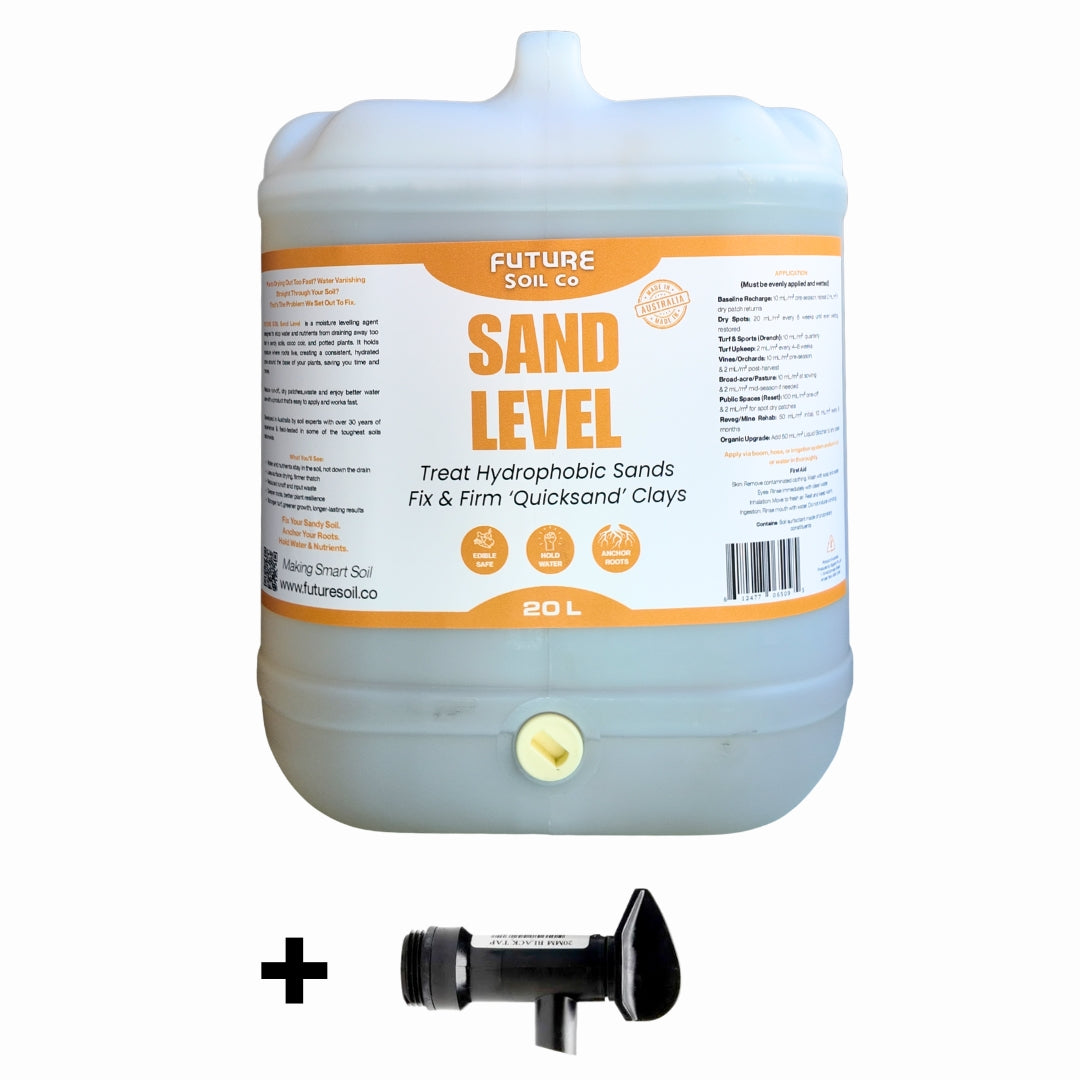
FUTURE SOIL® SAND LEVEL is a soil surface adjuvant designed to even moisture in sandy and sandy-loam soils, delivering more consistent wetting, fewer dry patches, and reduced slurry behaviour without changing soil structure.
If your sand drains too fast, wets unevenly, or leaves dry spots and muddy patches after irrigation, Sand Level gives water a better path.
Instead of water rushing straight down or pooling at a few spots, Sand Level helps it spread and soak evenly across the root zone.
The results?
✔ Dry patches diminish as water spreads more evenly
✔ Moisture stays in the root zone longer
✔ Less pooling and runoff after watering
✔ No hardening or binding, sand remains friable
✔ More even greens and turf surfaces
✔ Improved irrigation efficiency with the same water volume
Works On
• Loose sandy soils
• Sandy loams
• Hydrophobic sands
• Clay-contaminated sands
• Lawns & landscapes
• Sports turf & golf fairways
• Arboriculture & revegetation sites
• Arid and irrigated environments where consistent moisture matters
Application Guide
Application Guide
BEST RESULTS
- For sandy or sandy-dominant soils.
- Dilute with water and apply to moist soil.
- Water in evenly to distribute through the surface.
- Maintain normal irrigation after application.
FIRST TREATMENT – MOISTURE & SLURRY CONTROL
Dry Patches / Uneven Wetting: 5 mL/m²
Slurry-forming or quicksand-like sands (over-irrigated, silty, unstable sands): Apply: 10 mL/m²
(Water in evenly with application.)
OPTIONAL FOLLOW-UP
If dry patch or slurry behaviour persists, apply 2 mL/m² every 4–6 weeks until balance is restored.
Water in as per initial application.
REAPPLY IF
Dry patch returns.
Water runs straight through the profile.
Sand becomes slurry-like when saturated from clay contamination
Seasonal stress increases (heat, traffic, irrigation changes).
Why It's Different
Why It's Different
Polymer gels, super-absorbents, many wetting agents, and liquid nanoclays attempt to fix sand by adding mobile materials that swell, disperse, or migrate. In practice, these approaches often:
- Disrupt pore structure and sand hydraulics
- Accelerate slurry or shear-weak behaviour
- Degrade unpredictably over time
- Increase the risk of off-site movement through drainage
In sand, the problem is not water entry, but how water moves and distributes after entry.
SAND LEVEL works at the soil surface and upper profile to guide water by:
- Encouraging lateral moisture spread
- Delaying premature deep drainage
- Reducing dry patch and localised runoff
- Moderating slurry or quick-mud behaviour
This makes SAND LEVEL ideal for turf, landscapes, farms and revegetation where consistent moisture distribution matters.
How It Works
How It Works
FS SAND LEVEL is a soil surface adjuvant, it modifies water movement by adjusting surface charge and wetting behaviour at the sand grain interface.
Unlike wetting agents that only lower surface tension, Sand Level helps water spread evenly before gravity pulls it down, resulting in wider wetting fronts and better moisture distribution without altering soil structure.
Field Results
Field Results
Boundary Bend – Sandy Loam Orchard (Drip Irrigation)
• Improved lateral spread of irrigation water between emitters
• Reduced concentration of water directly beneath drip points
• More even wetting of the active root zone, improving irrigation efficiency
(Water behaviour improvement in sandy loam under drip irrigation)
⸻
Kagome – Processing Tomatoes, Portugal (Sandy Soil) - Full commercial Study .
• Yield increased by 17–24% compared to control plots
• Improved soil water retention in sandy soil (slaking test)
• Reduced blossom end rot (BER) and total rots
• Improved colour A/B ratio for processing quality
• No negative agronomic issues observed at applied rates
This confirms Sand Level’s ability to improve water availability and crop performance in sandy soils under production conditions.
⸻
Almond Orchard – Sandy Loam (Drip Irrigation)
• Improved wetting pattern along tree rows
• Reduced vertical water loss beneath emitters
• More consistent soil moisture across the irrigated strip
⸻
Golf Course – Sand-Based Fairways
• Reduced dry patch severity associated with algae and surface biofilm build-up
• More uniform surface moisture following irrigation
• Area remained free-draining with no surface binding or hardening
FAQ's
FAQ's
Will SAND LEVEL fix dry patch in sandy soil?
Yes.
SAND LEVEL evens moisture movement in sand so water spreads instead of skipping dry areas or draining straight through.
Dry patch commonly occurs in hydrophobic sands and sandy loams where irrigation water fails to distribute evenly. SAND LEVEL improves lateral moisture spread without compacting or binding sand.
Will it reduce puddles and muddy spots?
Yes.
By improving surface moisture distribution, SAND LEVEL reduces puddling and muddy patches caused by uneven watering or over-irrigation.
This is especially useful in sandy areas where water pools at sprinkler or drip points and leaves surrounding areas dry.
Will it make my sand hard or compact?
No.
SAND LEVEL does not bind, cement, or harden sand. Treated areas remain free-draining and workable.
It controls how water behaves in sand, not the physical structure of the soil.
Is SAND LEVEL just another wetting agent?
No.
Wetting agents help water enter soil.
SAND LEVEL controls where water goes after it enters.
This helps prevent water racing straight through the profile or pooling at the surface.
How long does SAND LEVEL last?
Longer than standard wetting agents.
Reapply only when dry patch, puddling, or uneven wetting returns, or after major soil disturbance.
There is no fixed reapplication schedule.
Is it safe for lawns, gardens, and vegetable beds?
Yes.
When used as directed, SAND LEVEL is safe for turf, ornamentals, and edible plants.
When do I need to reapply?
Reapply when:
- dry patch returns
- water runs straight through the soil
- muddy or boggy patches reappear
- soil has been disturbed or renovated
- seasonal stress increases (heat, traffic, irrigation changes)
Can I overapply SAND LEVEL?
Using more than recommended won’t improve results.
Low, even application works best.
Will it work with sprinklers and irrigation systems?
Yes.
SAND LEVEL is compatible with sprinklers, drip irrigation, hose-on application, and tank watering systems.
What soils should I NOT use SAND LEVEL on?
Do not use on:
- heavy clay soils
- soils needing structural remediation
For clay soils, use FUTURE SOIL® CLAY BREAKER instead.
Can I use SAND LEVEL with Liquid Biochar?
Yes.
SAND LEVEL controls how water spreads through sand. Liquid Biochar can be added separately to increase nutrient holding (CEC) and biological capacity.
Used together, SAND LEVEL improves moisture distribution, while Liquid Biochar helps retain nutrients and support root-zone biology. Each product does a different job and they can be applied independently or as part of a broader soil program.