Skip to product information
1 of 5

FUTURE SOIL

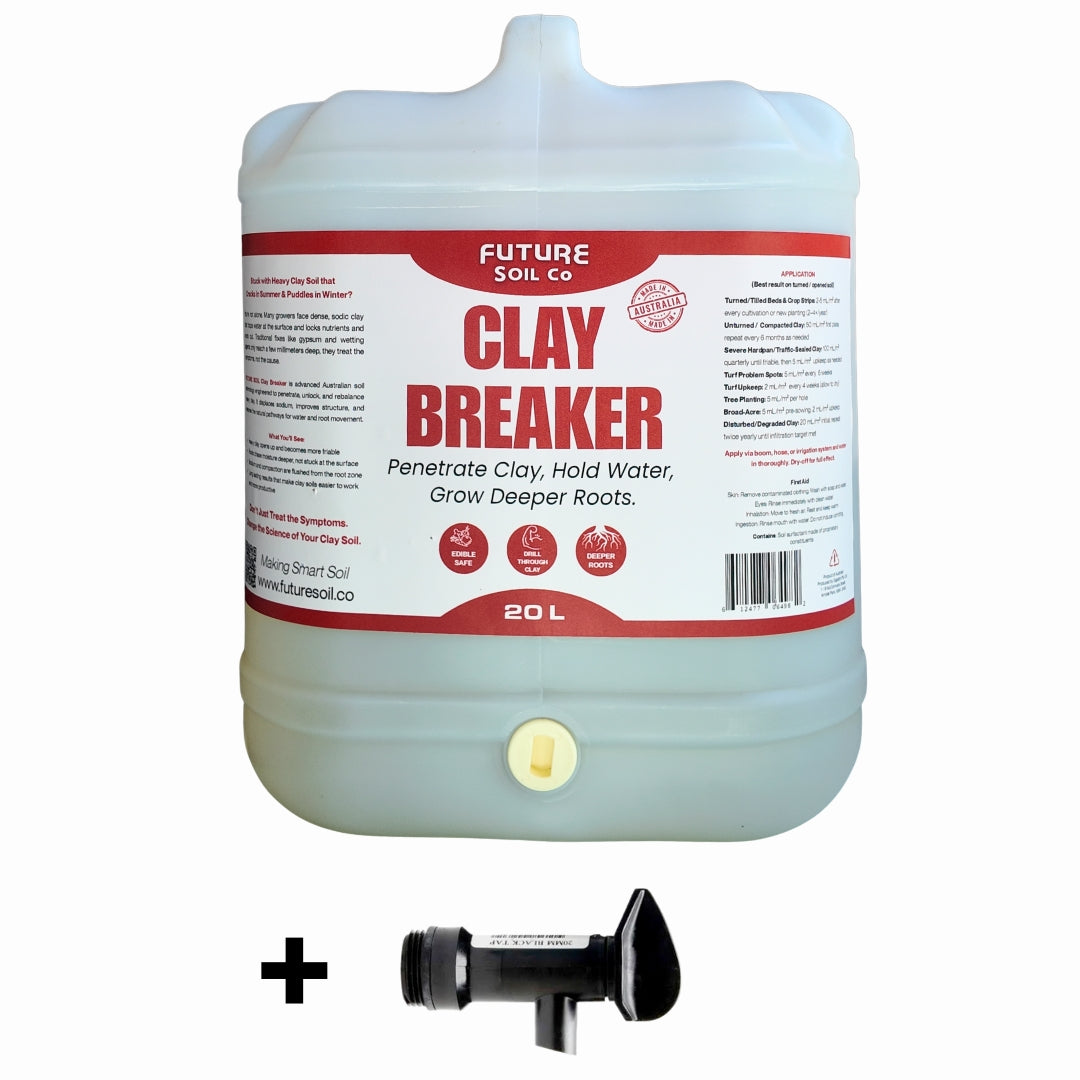
CLAY BREAKER

CLAY BREAKER

Regular price $29.00 AUD
Regular price Sale price $29.00 AUD
Sale Sold out
Size

Better, Deeper, Faster, Than Gypsum. 

FUTURE SOIL® CLAY BREAKER opens compacted, sodic, reactive, or hard-setting clay fast. It makes clay easier to dig and plant into, and improves water soak-in from the first application.

Powered by dual-action cationic and non-ionic chemistry, it penetrates to unlock deep air, water, and root flow.. As the soil dries, the structure sets into a stable profile that drains better, holds moisture longer, and supports stronger root growth.

Developed in Australia, this clean liquid formula replaces gypsum, penetrants, and wetting agents with a smarter, deeper, long-lasting alternative. No rocks, no shells, no debris. No hose-on failures. 

Safe around existing plants and edibles when used as directed. Works on all clay types, including hard-setting, sodic, dispersive, reactive, clay loam, and compacted subsoil.

Starts working immediately. Full improvement as the soil dries.

Release your nutrients and minerals from clay jail today.

How it Works

Cationic phase: The positively charged component binds to negatively charged clay particles, displacing sodium and reforming them into stable, friable crumbs.

Non-ionic phase: Lowers surface tension so water moves freely through the profile, carrying oxygen and nutrients into zones that were previously sealed.

Lasting effect: As the soil dries, the restructured clay sets into a network of micro-aggregates that stay open, drain evenly, and resist sealing after rain.

Why CLAY BREAKER Is Different

Most clay breakers only fix one problem. Gypsum targets sodic clay. Wetting agents move water but do not change structure. Liquid gypsum products soften the surface but cannot reach the deepest layers where roots need space.

FUTURE SOIL® CLAY BREAKER fixes all of these limitations at once.

Opens clay fast

Clay softens quickly so you can dig, plant, and water normally again.

Improves water soak-in immediately

Stops runoff, sealing, and pooling from the first application.

Deep action where roots grow

The non-ionic penetrant carries the actives deep into the profile. No other retail product can reach this depth without digging.

Rebuilds structure long term

The cationic phase reforms clay platelets into a more open, stable arrangement that drains better and breathes naturally.

Works on all clay types

Hard-setting, sodic, dispersive, reactive, compacted subsoil, clay loam. One solution for every garden.

Clean, pure, and safe

No rocks, shells, or debris that can damage mowers or destroy lawns.

FUTURE SOIL® CLAY BREAKER replaces gypsum, penetrants, and wetting agents with a single, smarter, more powerful Australian-engineered system.

Who's it For?

Field Results

Yering, VIC – Vineyard Clay:

Field cores showed rapid infiltration improvements and visible restructuring within 12 weeks. Treated rows exhibited deeper root activity, stronger shoot vigour, and sustained soil moisture compared with untreated control areas.

Gawler River, SA – Potatoes on Hard Grey Clay:

Compaction levels dropped from 2.4 MPa to 1.2 MPa in 45 days, allowing deeper root penetration and improved tuber set. Growers reported easier tillage, higher moisture retention, and more uniform tuber formation across treated beds.

Heathcote, VIC – Dense Sub-Soil Clay (Core Test):

A single drench of FUTURE SOIL® CLAY BREAKER transformed a 20 mm sealed surface into 280 mm of friable soil within 12 weeks. Within just 14 days, the upper 28 cm core showed complete restructuring — open, moist, and root-ready — with root growth rapidly following the improved profile.

Soil CRC Pot Trial – Sodic Clay (10–45 cm):

Clay dispersion (turbidity) reduced by 68 % at 10–20 cm depth and 34 % at 20–45 cm depth. Shoot biomass increased by 73 %, and the photosynthesis index rose by 16 %, demonstrating a measurable uplift in plant health and structural stability.

Application Guide

Turned or Tilled Beds / Crop Strips

Rate: 2–5 mL/m²  (20–50 L/ha)

Frequency: Every 4–6 weeks after cultivation or planting until friability is stable.

Moderately Compact Clay

Rate: 10–20 mL/m²  (100–200 L/ha)

Frequency: Every 4–6 weeks; allow drying between applications; incorporate where possible.

Severe Hard-Pan or Traffic-Sealed Clay

Rate: 100 mL/m²  (1000 L/ha)

Frequency: Every 4–6 weeks until friability is reached. Reapply only if clay contamination returns.

Turf – Problem Spots

Rate: 10 mL/m²  (100 L/ha)

Frequency: Every renovation or every 6 weeks until dry patch resolves.

Turf – General Upkeep

Rate: 2 mL/m²  (20 L/ha)

Frequency: Greens – every 4 weeks  •  Fairways / Lawns – every 6–8 weeks.

Vineyards / Orchards – Pre-Season

Rate: 10 mL/m²  (100 L/ha)

Timing: Apply once before bud-break or sap flow.

Vineyards / Orchards – Post-Harvest

Rate: 5 mL/m²  (50 L/ha)

Timing: Apply once after harvest each season

Broadacre – Seasonal Top-Up

Rate: 2–5 mL/m²  (20–50 L/ha)

Timing: Mid-season or after grazing compaction returns.

Disturbed / Degraded Clay – Mine Rehab, Erosion, Construction

Rate: 100–1000 mL/m²  (1000–10 000 L/ha)

Special Use: Up to 1 L/m² under paving, concrete, or driveways.

Frequency: One-off stabilisation; repeat only if compaction or erosion returns.

Adjuvant / Tank-Mix Use

• Can be added to any spray mix as a soil–surface adjuvant — perform a jar test if in doubt.

• Drives fertilisers, gypsum, lime, and biologicals deeper into the soil profile.

• Enhances nutrient mobility and exchange, improving input efficiency.

• Compatible with most liquid fertilisers and soil conditioners; avoid strong acids or solvents.

FAQ's

How does FUTURE SOIL® CLAY BREAKER deliver calcium movement?

Gypsum must first dissolve before its calcium ions can travel through the soil. CLAY BREAKER bypasses this limitation through a dual-action mechanism. The cationic component instantly displaces sodium from clay particles, while the non-ionic carrier drives calcium and other nutrients deep into the profile. This liquid delivery system restructures soil from within, ensuring calcium movement and clay stabilisation occur quickly and uniformly throughout the treated zone.

What makes FUTURE SOIL® CLAY BREAKER different from gypsum?

Gypsum is a solid amendment that must dissolve and move downward to affect clay, a slow and inefficient process that often fails to reach depth. CLAY BREAKER delivers calcium movement and clay restructuring instantly through a liquid cationic and non-ionic mechanism. It permanently rebuilds soil structure from within, without heavy spreading, machinery, or runoff loss.

Does it replace gypsum completely?

Yes, in most cases. CLAY BREAKER replicates and amplifies gypsum’s effect by knocking sodium off clay particles and driving calcium deeper through its non-ionic carrier. Where calcium levels are low, you can still co-apply gypsum or lime, CLAY BREAKER simply carries them further and makes them work faster.

How long does one application last?

Unlike wetting agents or surface surfactants, CLAY BREAKER’s restructuring is semi-permanent. Once the clay bonds are reset, the effect remains stable until the soil is mechanically disturbed (tilled, excavated, or heavily trafficked). Typical results last several years, with only light maintenance applications required.

Can it be used with fertilisers or biological products?

Yes. CLAY BREAKER is fully compatible with most fertilisers, biologicals, and soil nutrients. It can be added to any spray mix as a soil–surface adjuvant to improve penetration and nutrient mobility. Avoid combining with strong acids, solvents, or undiluted concentrates, perform a jar test if unsure.

Is it safe for turf, seedlings, and young roots?

Completely. The formulation is non-toxic and low-salinity, allowing use before seeding, during turf establishment, or as part of regular renovation programs. It improves germination by restoring air, water, and nutrient flow through the soil.

Can it be used under paving, turf systems, or roads?

Yes. CLAY BREAKER is increasingly used in civil and infrastructure projects to stabilise reactive clays before compaction or paving. It prevents post-construction swelling, shrinkage, and erosion beneath surfaces such as roads, sports fields, and synthetic turf systems.

How soon after application can I see results?

Light to moderate clay generally shows measurable improvements in infiltration and friability within 1–3 weeks. Heavily compacted or sodic soils may take up to 6 weeks and several wet–dry cycles for full structural change. Penetrometer readings below 1.5 MPa confirm success.

Is it affected by rainfall or irrigation?

Moderate rain or irrigation (10–15 mm within 24 hours) is required to activate the product and drive it into the profile. Heavy downpours immediately after application can cause surface wash-off, so avoid applying before major rain events.

Can it help with erosion or slope stabilisation?

Yes. CLAY BREAKER bonds fine clay into stable aggregates that resist surface wash-off and sealing. It’s effective in erosion-prone embankments, rehabilitation zones, and disturbed soils, improving infiltration and vegetative cover establishment.

Is it environmentally safe?

Yes. CLAY BREAKER contains no synthetic polymers or persistent surfactants. It remains bound to the soil mineral phase and does not leach into waterways. Its action restores natural soil structure and supports microbial activity rather than suppressing it.

How does it interact with lime or gypsum if co-applied?

It enhances them. The non-ionic carrier drives these solids deeper, allowing faster cation exchange and calcium integration into the profile. The combined effect is stronger aggregate formation and faster recovery of compacted or sodic soils.

Does it help improve irrigation efficiency?

Yes, by reopening the capillary network and increasing infiltration, CLAY BREAKER reduces runoff and allows more water to enter and remain in the root zone. Users typically see reduced irrigation volumes and more uniform soil moisture across treated areas.

Can it be used on sandy or duplex soils?

Yes. While designed for clay, CLAY BREAKER’s chemistry also assists in binding fine sand and clay fractions within duplex profiles, improving stability and nutrient-holding capacity in transitional soils.

What equipment can I use to apply it?

Compatible with boom sprayers, hydroseeders, slurry tanks, coarse nozzles, and watering systems. Avoid high-foaming or fine mist nozzles. Ensure even coverage and irrigate within 24 hours of application.

What’s the shelf life and storage requirement?

Shelf life is 24 months when stored upright and sealed between 5–35 °C. Avoid freezing or prolonged exposure to direct sunlight. Shake or agitate before use.

View full details