FUTURE SOIL
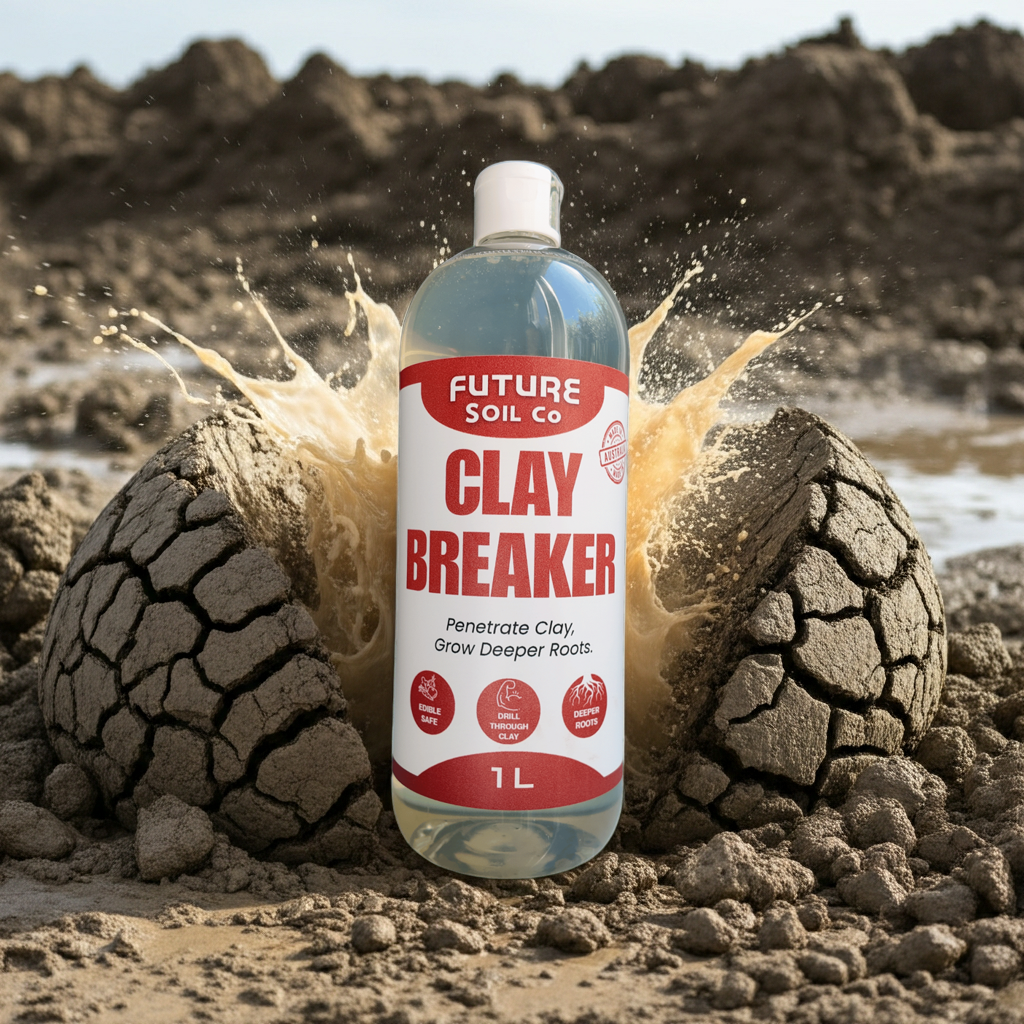
CLAY BREAKER Soil Conditioner
CLAY BREAKER Soil Conditioner
Couldn't load pickup availability
FS CLAY BREAKER
Stop Water Sitting on Top. Stop Clay Turning to Concrete.
If your clay soil turns into sticky mud when wet and hard rock when dry, you are dealing with unstable clay. If it's hard to dig and plants struggle. (sodic or dispersive clay).
That kind of clay:
- Gets greasy and messy after rain
- Puddles and holds water on the surface
- Washes irrigation away
- Crusts and seals over
- Dries into hard blocks
- Cracks and chokes roots
- Keeps roots shallow
- Wastes fertiliser
- Delivers patchy growth
FS Clay Breaker uses world-first dual-action chemistry combining non-ionic wetting behaviour with cationic surface charge to control soil surface energy and water movement.
- It reduces the mud-and-seal effect when wet.
- It reduces the concrete effect when dry.
- It helps water soak in instead of sitting on top.
- It allows roots to push deeper instead of stopping at the surface.
Not a band-aid.
An easy to use and long-lasting structural reset for problem clay.
Proven Results
Sugar Cane – Ingham QLD
• 58.65 t/ha vs 55.76 t/ha control
• +2.89 t/ha yield increase
Water-Stable Clay – Wannamara VIC
• 25% greater water performance vs gypsum
• 17% greater water performance vs untreated soil
Yering Station VIC – Vineyard
• Roots extended from 30 cm to 1 metre
Pot Wheat Trial – Gypsum Comparison
• −68% turbidity (10–20 cm)
• −34% turbidity (20–45 cm)
Measured improvement in water movement.
Measured improvement in structure.
Measured improvement in root depth and yield.
What that means for you:
- Less run-off.
- Less puddling.
- Less hard-setting.
- Deeper roots.
- Stronger plants.
- Better yields.
Fast acting.
- Long lasting.
- Easy to apply through sprayer or watering can.
- Works with your existing fertiliser and gypsum program and helps them perform better.
Fix the clay and everything above it improves.
FUTURE SOIL®
Earth Changing Technology.
How it Works
How it Works
FS CLAY BREAKER modifies the surface charge and surface energy of clay particles. This resets how clay interacts with water, allowing previously sealed soils to reopen and drain evenly without collapsing or sealing after rainfall or irrigation.
Rather than dissolving and leaching through the profile, the active system fixes to soil particles as the soil dries, creating a stable, open structure that supports controlled water movement and long-term soil function.
Reapplication is only required if the soil is physically disturbed through excavation, tillage, or heavy trafficking.
Application Guide
Application Guide
Application Guide
- Best results on open, turned, or forked (aerated) soil
- Dilute with water and apply to moist soil.
- Water in evenly with application.
- Allow soil to dry fully to set structure.
(normal drying between irrigation is sufficient)
FIRST TREATMENT - STRUCTURAL RESET:
Turned / open clay: 5 mL/m²
Compacted / unturned clay: 20 mL/m²
OPTIONAL FOLLOW-UP:
Turned clay: 2 mL/m² if surface sealing persists after drying
Compacted clay: 5 mL/m² if infiltration remains restricted after drying
REAPPLY WHEN:
- Soil is disturbed (digging, renovation, heavy traffic).
- New dispersive clay is introduced or exposed, in which case a top-up application extends treatment to the newly affected surfaces.
Field Results
Field Results
Yering, VIC – Vineyard Clay:
- Roots pushed to ~1 m depth
- Faster infiltration, steadier soil moisture
Gawler River, SA – Potatoes on Hard Grey Clay:
- Soil strength halved in 45 days
- Deeper roots and more uniform tuber set
Heathcote, VIC – Dense Sub-Soil Clay (Core Test):
- Sealed surface opened to active root zone
- Rapid root growth through restructured profile
Soil CRC Pot Trial – Sodic Clay (10–45 cm):
- Clay dispersion reduced by up to 68 percent
- Biomass increased by 73 percent
FAQ's
FAQ's
How do you fix clay soil that won’t drain?
Clay that won’t drain usually seals at the surface. CLAY BREAKER improves infiltration by stabilising clay behaviour so water can enter and move through the soil instead of pooling or running off.
Why does clay become boggy in winter and rock hard in summer?
This is a classic wet–dry clay failure. CLAY BREAKER prevents sealing when wet and hard-setting when dry by stabilising clay structure across moisture cycles.
Is CLAY BREAKER the same as a wetting agent?
No. Wetting agents temporarily reduce surface tension. CLAY BREAKER is a soil surface engineering treatment designed to deliver long-term structural stability.
How is CLAY BREAKER different from gypsum?
Gypsum relies on dissolving and moving through the soil. CLAY BREAKER stabilises clay behaviour directly and restores infiltration without heavy mineral loading.
Does CLAY BREAKER remove sodium?
It restores water movement, allowing sodium to be flushed naturally from the root zone through rainfall or irrigation.
How long does it last?
The modification is permanent on treated clay surfaces. If new dispersive clay is introduced or exposed, a top-up application extends treatment to the new surfaces.
Are there soils where CLAY BREAKER is not needed?
Yes. Well-structured clays with good natural aggregation and infiltration usually do not require CLAY BREAKER.
Is it safe for lawns, gardens, and agriculture?
Yes, when used as directed.