FUTURE SOIL
Couldn't load pickup availability
Watering often and your soil still dries out too fast?
Dry patches. Uneven growth. Water disappearing straight through. Nutrients washing past the roots.
Sandy, gravelly and free draining soils can be difficult to keep evenly wet. You irrigate more often, but parts of the rootzone still dry out while water drains too deeply elsewhere.
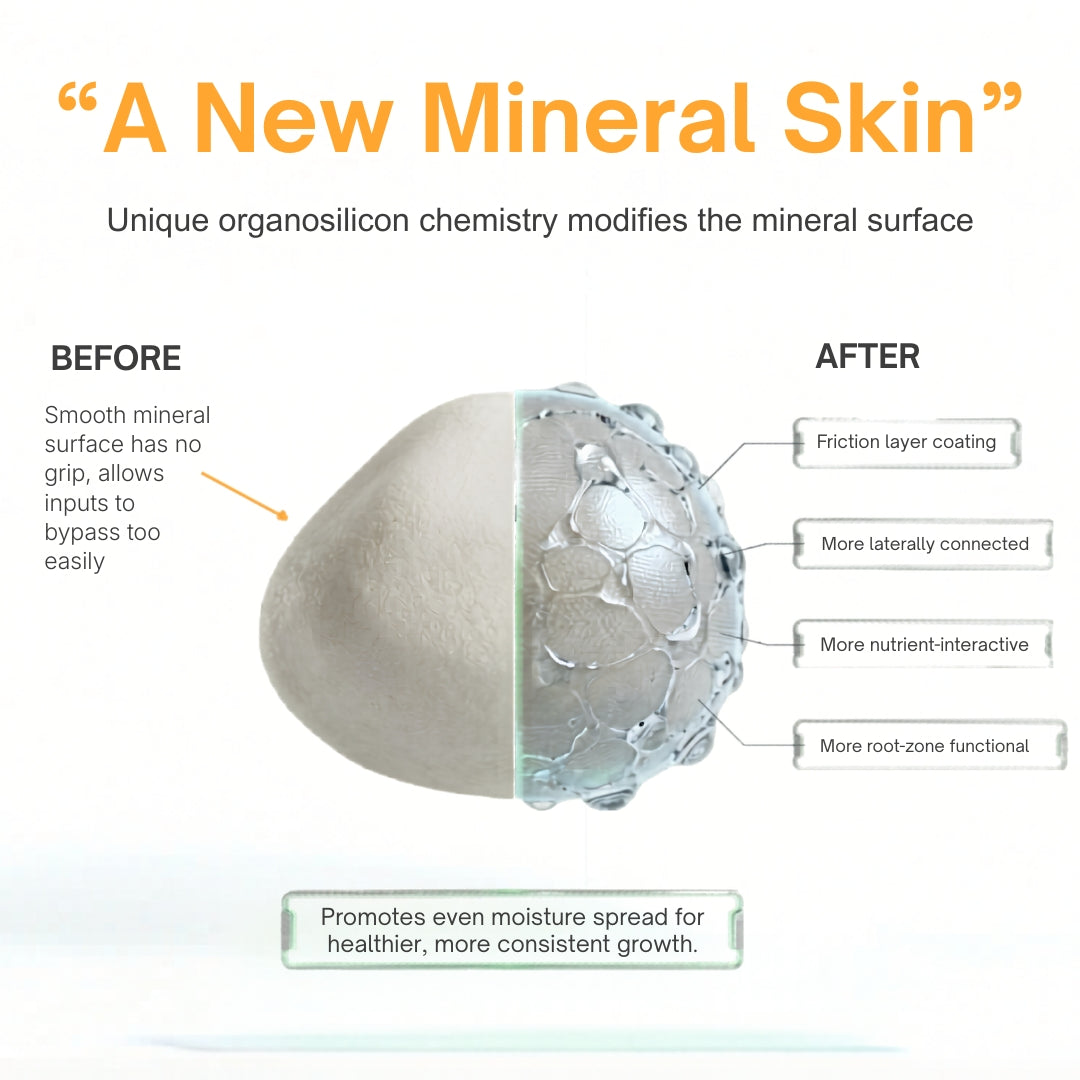
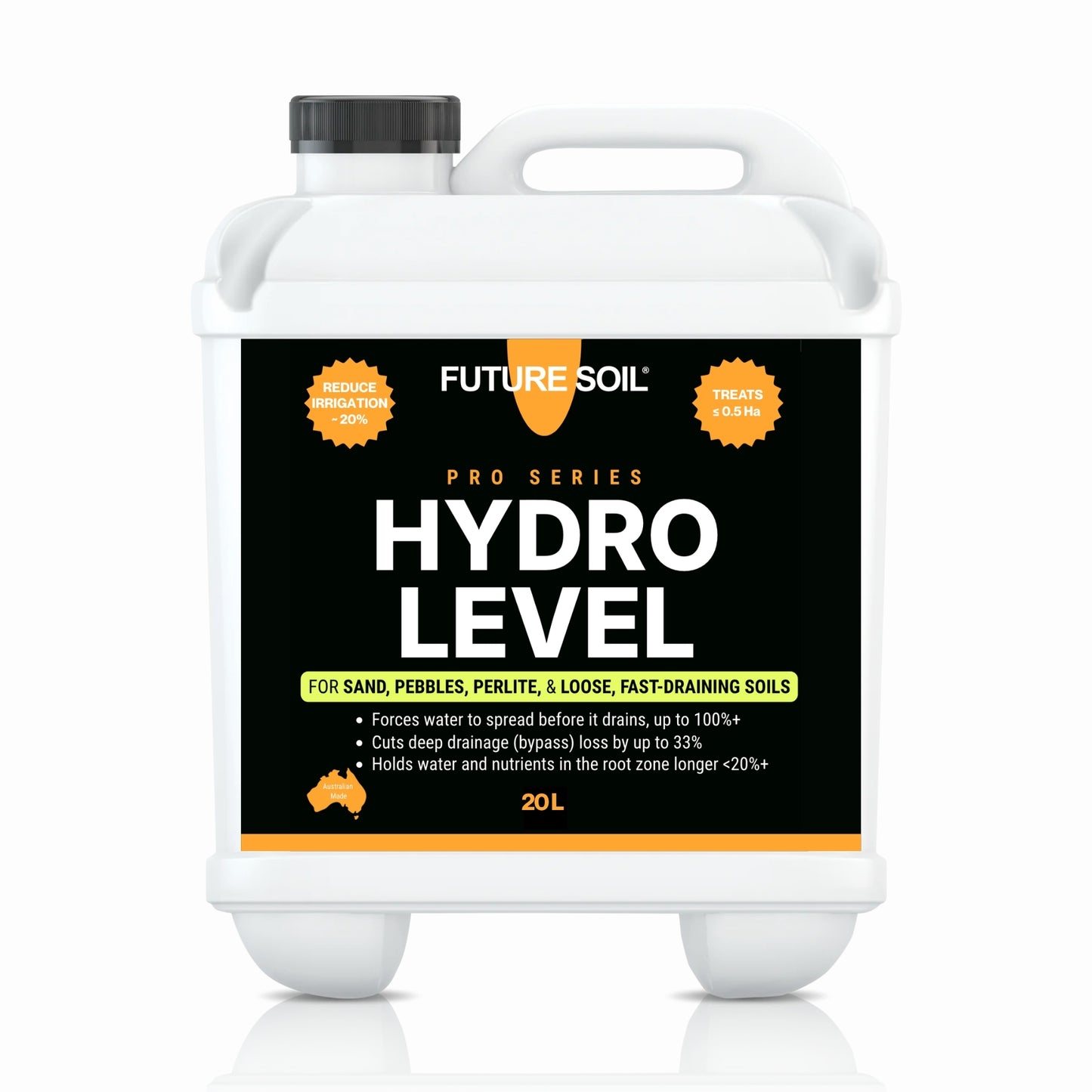
FS HYDRO LEVEL binds to the soil surface and creates a long lasting change in how water, nutrients and additives spread through the profile.
It helps water move further sideways, creating a wider and more even wetted zone.
The outcome
- Fewer dry patches
- More even rootzone moisture
- Less water lost below the roots
- Less frequent irrigation
- Better use of applied nutrients
- Stronger, more consistent growth
Proven performance
- More than 100% increase in lateral water spread
- Up to 30% less deep drainage
- Up to 20% less irrigation required
Stop watering more. Start spreading water properly.
FS HYDRO LEVEL binds to soil and spreads every irrigation further.
www.futuresoil.co
Application Guide
Application Guide
BEST RESULTS
- For sandy or sandy-dominant soils.
- Dilute with water and apply to moist soil.
- Water in evenly to distribute through the surface.
- Maintain normal irrigation after application.
FIRST TREATMENT – MOISTURE & SLURRY CONTROL
Dry Patches / Uneven Wetting: 5 mL/m²
Slurry-forming or quicksand-like sands (over-irrigated, silty, unstable sands): Apply: 10 mL/m²
(Water in evenly with application.)
OPTIONAL FOLLOW-UP
If dry patch or slurry behaviour persists, apply 2 mL/m² every 4–6 weeks until balance is restored.
Water in as per initial application.
REAPPLY IF
Dry patch returns.
Water runs straight through the profile.
Sand becomes slurry-like when saturated from clay contamination
Seasonal stress increases (heat, traffic, irrigation changes).
FAQ's
FAQ's
Will SAND LEVEL fix dry patch in sandy soil?
Yes.
SAND LEVEL evens moisture movement in sand so water spreads instead of skipping dry areas or draining straight through.
Dry patch commonly occurs in hydrophobic sands and sandy loams where irrigation water fails to distribute evenly. SAND LEVEL improves lateral moisture spread without compacting or binding sand.
Will it reduce puddles and muddy spots?
Yes.
By improving surface moisture distribution, SAND LEVEL reduces puddling and muddy patches caused by uneven watering or over-irrigation.
This is especially useful in sandy areas where water pools at sprinkler or drip points and leaves surrounding areas dry.
Will it make my sand hard or compact?
No.
SAND LEVEL does not bind, cement, or harden sand. Treated areas remain free-draining and workable.
It controls how water behaves in sand, not the physical structure of the soil.
Is SAND LEVEL just another wetting agent?
No.
Wetting agents help water enter soil.
SAND LEVEL controls where water goes after it enters.
This helps prevent water racing straight through the profile or pooling at the surface.
How long does SAND LEVEL last?
Longer than standard wetting agents.
Reapply only when dry patch, puddling, or uneven wetting returns, or after major soil disturbance.
There is no fixed reapplication schedule.
Is it safe for lawns, gardens, and vegetable beds?
Yes.
When used as directed, SAND LEVEL is safe for turf, ornamentals, and edible plants.
When do I need to reapply?
Reapply when:
- dry patch returns
- water runs straight through the soil
- muddy or boggy patches reappear
- soil has been disturbed or renovated
- seasonal stress increases (heat, traffic, irrigation changes)
Can I overapply SAND LEVEL?
Using more than recommended won’t improve results.
Low, even application works best.
Will it work with sprinklers and irrigation systems?
Yes.
SAND LEVEL is compatible with sprinklers, drip irrigation, hose-on application, and tank watering systems.
What soils should I NOT use SAND LEVEL on?
Do not use on:
- heavy clay soils
- soils needing structural remediation
For clay soils, use FUTURE SOIL® CLAY BREAKER instead.
Can I use SAND LEVEL with Liquid Biochar?
Yes.
SAND LEVEL controls how water spreads through sand. Liquid Biochar can be added separately to increase nutrient holding (CEC) and biological capacity.
Used together, SAND LEVEL improves moisture distribution, while Liquid Biochar helps retain nutrients and support root-zone biology. Each product does a different job and they can be applied independently or as part of a broader soil program.