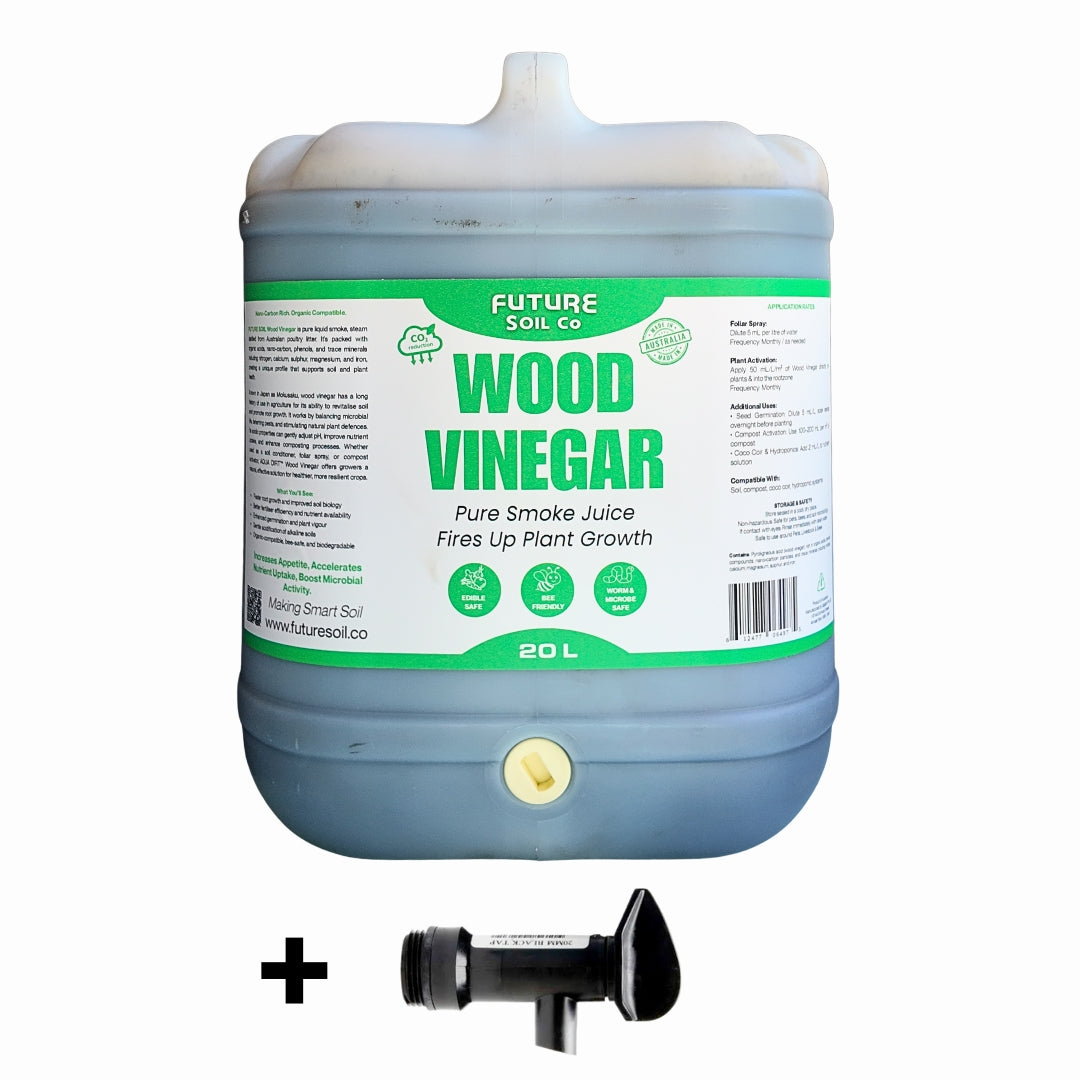
FUTURE SOIL
WOOD VINEGAR
WOOD VINEGAR
Couldn't load pickup availability
Plant & Soil Stimulant | 100 % Natural Smoke Extract
FUTURE SOIL® WOOD VINEGAR is a natural bio-stimulant distilled from clean Australian biomass. Rich in acetic acid, phenols, and esters, the same compounds that trigger regrowth after fire, it reactivates soil biology and accelerates plant development.
How it Works
How it Works
Plant Growth Biostimulant
Stimulates root, shoot, flower, and fruit development for stronger, more vigorous plants.
Microbial Balance in Soil
Encourages beneficial microbes while suppressing harmful soil organisms and disease pressure in the root zone.
Better Nutrient Uptake
Improves absorption of existing fertilisers, helping plants take up more nutrients from the same application.
Natural Pest and Disease Support
Acts as a natural deterrent for certain insects and fungal problems when used at higher dilutions in foliar sprays.
Stress and Recovery Support
Helps plants cope with transplant shock, pruning, drought, and heat by supporting healthier root function and recovery.
Seed and Propagation Booster
Improves germination strike rate and early root establishment when used as a diluted seed soak or cutting treatment.
Compost and Odour Management
Speeds up composting of organic matter and reduces ammonia and organic odours in manures and waste heaps.
Who is it For?
Who is it For?
Market Gardens & Organic Growers
Used as a biostimulant to enhance root and shoot growth, improve nutrient uptake, and reduce reliance on synthetic fertilisers in vegetable and herb production.
Tree Crops, Orchards & Vineyards
Applied as a diluted foliar or root drench to strengthen root activity, improve flowering and fruit set, and mitigate stress from heat, pruning, or salinity.
Broadacre Farmers & Regenerative Systems
Used in combination with fertilisers or compost teas to increase nutrient efficiency, improve soil biological activity, and enhance crop resilience under dryland conditions.
Nurseries & Propagation Houses
Applied as a seed soak or cutting dip to boost germination rates, reduce damping-off, and promote healthy root formation in young plants.
Hydroponic & Controlled-Environment Growers
Used in low doses to regulate microbial populations in nutrient solutions and to reduce odour or algae buildup in recirculating systems.
Livestock & Poultry Operators
Sprayed in sheds or on bedding to neutralise odour, suppress pathogens, and improve hygiene naturally without chemical disinfectants.
Composting & Waste Management Sites
Speeds up decomposition, reduces ammonia loss, and stabilises organic matter during composting or manure treatment.
Landscape, Turf & Lawn Maintenance
Applied to revive soil biology in tired or compacted lawns, reduce thatch build-up, and improve grass recovery from heat or traffic stress.
Horticultural Retail & Home Gardeners
Ideal for regular use in watering cans or spray bottles to invigorate pot plants, vegetable patches, and ornamental beds for greener, stronger growth.
Field Results
Field Results
- +21 % average yield and +25 % biomass across 33 crops at optimum dilution
- Up to ~31 % yield lift at dialled-in rates
- 20–40 % biomass gains documented in lettuce, tomato, rice, and other vegetables under low-rate foliar sprays
- Improved soil biology and organic matter at ≤1 % soil applications
- Up to 35 % less ammonia and up to 60 %+ less methane from manures and composts when combined with biochar
Application Guide
Application Guide
(All figures referenced from peer reviewed publications with full authors listed.)
• +21 percent average yield across 33 crops (Leifeld, 2024)
• +25 percent average biomass (Leifeld, 2024)
• Up to ~31 percent yield lift at optimum dilution (Leifeld, 2024)
• 20 to 40 percent biomass gains in vegetables under low-rate foliar sprays (Leifeld, 2024)
• Soil organic matter increases at ≤1 percent soil application (Leifeld, 2024)
• Improved microbial activity and nutrient availability (Gu, Zhu, Li, Zhang, Chen, Jin, Zhang and He, 2024)
• 18.8 to 35.9 percent less ammonia during manure composting (Wang, Li, Shafi, An, Xiao, Chen, Wang and Liu, 2022)
• 16.98 to 62.73 percent less methane with wood vinegar plus biochar (Wang, Li, Shafi, An, Xiao, Chen, Wang and Liu, 2022)
• 50 to 61 percent methane reduction and 64 to 74 percent ammonia reduction in related systems using wood vinegar with biochar and zeolite (Wang, Li, Shafi, He, Wang, Chen and Wang, 2018)
FAQ's
FAQ's
1. What exactly is wood vinegar?
Wood vinegar, also known as pyroligneous acid or mokusaku, is the liquid condensate captured during the slow pyrolysis of wood and other plant biomass. It contains a balanced spectrum of organic acids, phenols, esters, alcohols, and ketones that act as natural biostimulants, microbial regulators, and compost accelerants.
2. How does wood vinegar work in the soil?
When diluted and applied to soil, its organic acids stimulate beneficial microbes and enhance nutrient cycling. The phenolic compounds regulate pathogen activity, while mild acidity helps mobilise nutrients, balance pH in alkaline soils, and improve plant uptake efficiency.
3. Is it a fertiliser?
No — wood vinegar is a biostimulant, not a fertiliser. It doesn’t supply large quantities of nutrients but makes existing nutrients more available and helps plants use them more effectively. It can be used alongside composts, fertilisers, or biochar to improve performance.
4. What crops or systems benefit the most?
Wood vinegar benefits nearly all crops when used correctly, including:
• Vegetables, herbs, and greenhouse crops
• Orchards and vineyards
• Turf, lawns, and ornamentals
• Cereals and broadacre crops
• Pasture and forage systems
• Composting and manure management
• Organic or regenerative production systems
5. What dilution rate should I use?
It depends on the application:
• Foliar spray: 1 : 200 – 1 : 500
• Soil drench / fertigation: 1 : 300 – 1 : 500
• Seed soak: 1 : 500 – 1 : 800
• Composting / odour control: 1 : 50 – 1 : 100
• Livestock sheds: 1 : 50 – 1 : 100
Always test a small area before large-scale use.
6. Can wood vinegar burn plants?
At high concentrations, yes. Wood vinegar is naturally acidic (pH 2–3). Always dilute as recommended and avoid applying during the hottest part of the day or onto wet leaves under strong sun.
7. How often should it be applied?
• Foliar or root applications: every 1–2 weeks during growth.
• Soil and compost treatments: monthly or as required.
• Odour and sanitation uses: weekly.
8. Can I mix it with fertiliser or pesticides?
It mixes well with most organic fertilisers, seaweed, humic acids, and compost teas. Avoid mixing with alkaline materials (lime, baking soda, or high-pH inputs) or synthetic pesticides, which can neutralise its acidity or react chemically.
9. Does it replace biochar or compost?
No — it complements them.
• Biochar provides stable carbon and structure.
• Compost supplies nutrients and organic matter.
• Wood vinegar activates microbial processes and improves nutrient efficiency.
Together they form a powerful regenerative trio.
10. How does it help with pests and disease?
The organic acids and phenols in wood vinegar create an environment that discourages certain soft-bodied insects and fungal pathogens. It can suppress mildew, damping-off, and odour-causing microbes, especially when used preventatively.
11. Is it safe for animals and humans?
Yes — when diluted correctly. It is a natural condensate with no synthetic additives. Avoid inhaling vapours or using undiluted product on skin or plants. Store away from children and food products.
12. How long do its effects last?
Wood vinegar acts biologically and chemically over weeks to months. Soil microbial effects and improved nutrient uptake can persist for several crop cycles when used regularly with compost or organic matter.
13. Does it qualify as organic?
Yes. Pure wood vinegar derived from untreated biomass and produced under controlled pyrolysis is accepted under most organic certification programs (check your local authority for compliance).
14. What results can I expect?
Across studies and field trials, properly diluted wood vinegar has shown:
• Up to 20–40 % increases in plant biomass and yield
• Improved germination and root development
• Reduced fertiliser use by 10–30 % through higher nutrient efficiency
• Lower odour and greenhouse-gas emissions in compost and manure systems
15. How should it be stored?
Keep sealed in its original container, out of direct sunlight, at 5 – 35 °C. Sediment or mild odour variation is normal and indicates a natural product.
16. What’s the shelf life?
24 months unopened and stored correctly. Shake well before use.
17. Does it have any environmental benefits?
Yes. It’s fully biodegradable, derived from renewable biomass, reduces ammonia and methane emissions, and promotes soil carbon retention through enhanced biological activity — all supporting regenerative and low-emission farming systems.